 DriftEngine
The project's AGENTS.md
The file most coding agents read when they open a folder: the commands, the rules a compiler cannot check, and what done means there, which is a passing check and both pictures looked at.
Orbfall is a small 3D arcade game. A coding agent built it with DriftEngine from the one prompt below, in about 14 minutes, starting from the command that starts every new project.
Make me a small 3D arcade game that runs in the browser. You pilot a hovering orb across a floating island at dusk, collecting glowing crystals while rolling boulders try to knock you off the edge. A run lasts 60 seconds; show the score, the time left and the best score, and let me restart. It should play with the keyboard, a gamepad or a touch screen, and have sound for pickups and hits.
As it was given, kept in the game's repository as PROMPT.md.
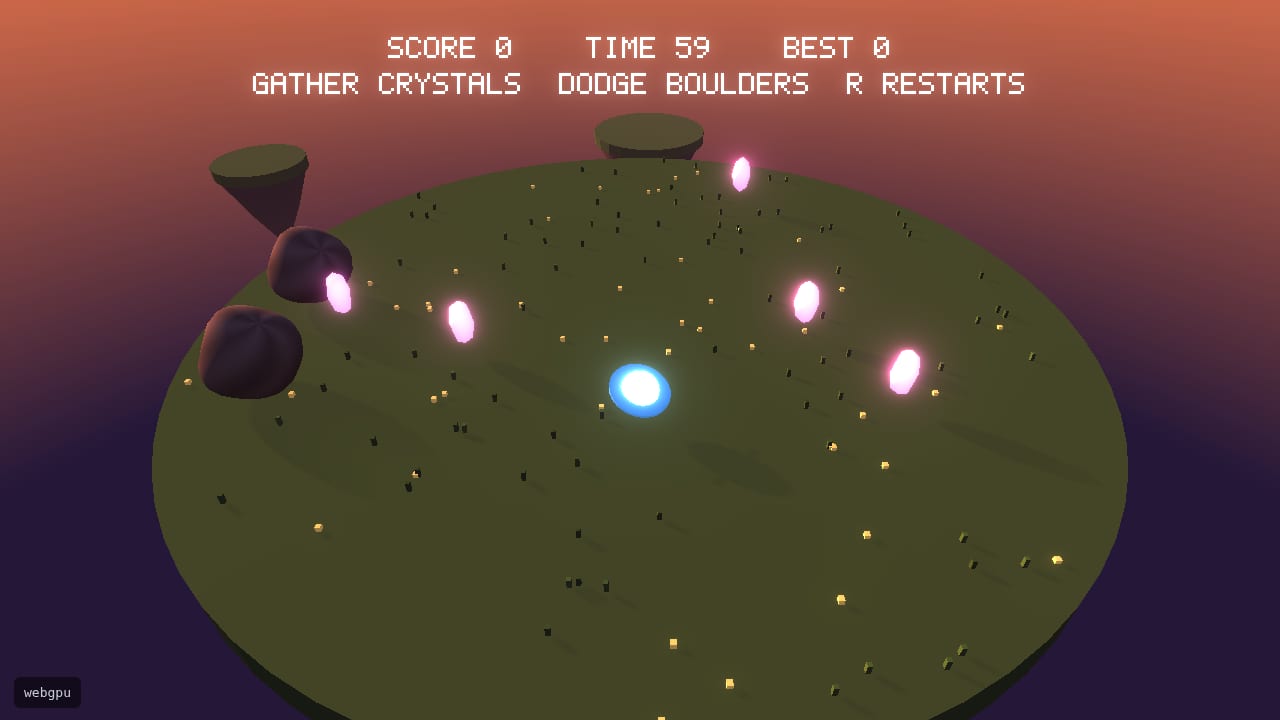 Play Orbfall
It loads the game into the page. Sound starts with your first key or tap.
Play it full screen at orbfall.driftengine.devOpen it on a page of its own
Three things, all of them written into the folder by npm create @driftengine@latest.
The file most coding agents read when they open a folder: the commands, the rules a compiler cannot check, and what done means there, which is a passing check and both pictures looked at.
The shape of a program, and where every page of the manual and every example is, at the version the project installed. It is written where Claude Code, Codex and Cursor look for skills.
A typecheck, the rules' tests in Node, then the game photographed on WebGPU and on WebGL2 with the machine's own GPU. It is how the agent saw the island it was building, and the log says what each picture showed.
The repository holds the game as the agent left it, its commits from the first request to the finished game, and its build log, written as it worked: every check, and every time it opened the pictures and what it saw in them.
The repositoryThe build logThe promptorbfall.driftengine.dev
npm create @driftengine@latest my-gameIt asks nothing and installs nothing, so an agent can run it unattended. Then npm install, npm run dev, and a prompt of your own.
Join the Discord Ask questions, share what you are building, and talk with other developers.
info@driftengine.dev