 DriftEngine
Rendering
Instancing
Thousands of copies of one mesh in one call, culled, moved every frame or played as a crowd, still draws recorded once, and foliage in the wind.
npm install @driftengine/core
Drawing a mesh a thousand times with drawMesh costs a thousand draws and, if the material changes
between them, a thousand material changes. An instanced batch draws every copy in one call, with one
material, from an array of model matrices and tints.
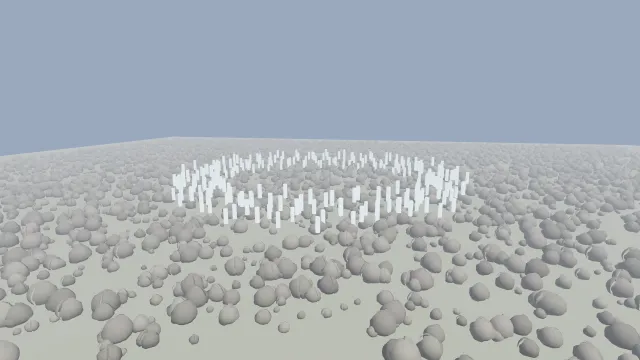
Starts examples/instancing in this page, on WebGPU where your browser has it.
A batch
/** A lumpy rock: a sphere whose radius varies by a hash of where on it you are. */
const rock = renderer.createMesh(
  new MeshBuilder()
    .addBlob(
      [0, 0.35, 0],
      (u, v) => 0.5 + hashToUnit(Math.floor(u * 7) * 31 + Math.floor(v * 5)) * 0.18,
      [0.55, 0.52, 0.48],
    )
    .build(),
);

const REGIONS = 4;
const PER_REGION = 625;
const SPAN = 120;
const random = mulberry32(7);

/** One batch per region, so a region out of view is skipped in one test. */
const fields: { batch: InstancedHandle; data: MeshInstances }[] = [];
for (let rx = 0; rx < REGIONS; rx += 1) {
  for (let rz = 0; rz < REGIONS; rz += 1) {
    const data = createMeshInstances(PER_REGION);
    for (let i = 0; i < PER_REGION; i += 1) {
      const x = (rx + random()) * (SPAN / REGIONS) - SPAN / 2;
      const z = (rz + random()) * (SPAN / REGIONS) - SPAN / 2;
      place(data.models, i, x, 0, z, random() * Math.PI * 2, 0.2 + random() * 0.8);
      const shade = 0.42 + random() * 0.3;
      data.tints.set([shade, shade * (0.95 + random() * 0.1), shade * 0.95], i * 3);
    }
    data.count = PER_REGION;
    const batch = renderer.createInstanced(rock, PER_REGION, { cull: true });
    renderer.uploadInstanced(batch, data);
    fields.push({ batch, data });
  }
}createMeshInstances(capacity) allocates the per-instance arrays once: models, sixteen floats per
instance, and tints, three, multiplied into the mesh's colour as a drawMesh tint is. count says
how many are live. createInstanced(mesh, capacity, options) attaches a batch to a mesh you already
uploaded, so a model with tens of thousands of triangles is not copied again. uploadInstanced sends
the arrays to the device.
/** Write a model matrix that scales, turns about Y and moves, into slot `i` of a batch. */
function place(
  out: Float32Array,
  i: number,
  x: number,
  y: number,
  z: number,
  yaw: number,
  s: number,
): void {
  const o = i * 16;
  const c = Math.cos(yaw) * s;
  const n = Math.sin(yaw) * s;
  out[o] = c;
  out[o + 1] = 0;
  out[o + 2] = -n;
  out[o + 3] = 0;
  out[o + 4] = 0;
  out[o + 5] = s;
  out[o + 6] = 0;
  out[o + 7] = 0;
  out[o + 8] = n;
  out[o + 9] = 0;
  out[o + 10] = c;
  out[o + 11] = 0;
  out[o + 12] = x;
  out[o + 13] = y;
  out[o + 14] = z;
  out[o + 15] = 1;
}A model matrix is sixteen floats, column-major. This helper writes one that scales, turns about Y and translates, which is most of what scattered props need.
Culling a batch
{ cull: true } tests the whole batch first, its enclosing box against the view and against any
declared occluders, and skips it in one test when it is out of sight. Then it tests each instance
by its bounding sphere. On WebGL2 the survivors are compacted on the CPU; on WebGPU a compute pass
writes an indirect draw, and the two are held to the same result.
One batch per region, as in the example, is what makes the first test pay: a region behind the camera costs one box test for all of its rocks. A mesh may have as many batches as you have regions.
Compaction does not keep instance order. That is invisible for opaque geometry, and it is why blended batches are not culled on the GPU.
Moving instances
/** Crystals circling the middle: the same batch, rewritten in place every frame. */
const CRYSTALS = 240;
const crystal = renderer.createMesh(
  new MeshBuilder().addCylinder([0, 0.6, 0], 0.18, 0.6, 'y', [0.55, 0.85, 1], 1.2, 6).build(),
);
const ring = createMeshInstances(CRYSTALS);
ring.count = CRYSTALS;
for (let i = 0; i < CRYSTALS; i += 1) ring.tints.set([1, 1, 1], i * 3);
const ringBatch = renderer.createInstanced(crystal, CRYSTALS);

function moveCrystals(time: number): void {
  for (let i = 0; i < CRYSTALS; i += 1) {
    const a = (i / CRYSTALS) * Math.PI * 2 + time * 0.2;
    const r = 14 + Math.sin(i * 1.7 + time) * 2;
    place(
      ring.models,
      i,
      Math.cos(a) * r,
      1 + Math.sin(time * 1.5 + i) * 0.8,
      Math.sin(a) * r,
      time + i,
      1,
    );
  }
  renderer.uploadInstanced(ringBatch, ring);
}A batch whose instances move is rewritten in place and uploaded every frame. Nothing is allocated,
because the arrays were sized at creation and only count instances are written.
Drawing
render() {
  camera.position[0] = Math.sin(time * 0.05) * 40;
  camera.position[1] = 9;
  camera.position[2] = Math.cos(time * 0.05) * 40;
  camera.lookAt(0, 1, 0);
  moveCrystals(time);

  renderer.beginFrame([0.6, 0.66, 0.74]);
  renderer.bindMeshPass(camera, ENV);
  renderer.drawMesh(ground, still.worldMatrix);
  for (let i = 0; i < fields.length; i += 1)
    renderer.drawInstanced(fields[i].batch, fields[i].data);
  renderer.drawInstanced(ringBatch, ring);
  renderer.endFrame();
},drawInstanced draws with whatever material is set, exactly as drawMesh does, and spends one slot
of the frame's material ring for the whole batch. drawTranslucentInstanced is the blended twin, for
glass and other see-through instances; see Translucent and additive meshes.
Each instance its own opacity
/** Panes pulsing out of step: an opacity an instance, uploaded with the rest of the batch. */
export function fadingPanes(
  renderer: RendererApi,
  batch: InstancedHandle,
  panes: MeshInstances,
  time: number,
): void {
  const alphas = panes.alphas;
  if (alphas !== undefined) {
    for (let i = 0; i < panes.count; i += 1) alphas[i] = 0.5 + 0.5 * Math.sin(time + i);
  }
  renderer.uploadInstanced(batch, panes);
  renderer.drawTranslucentInstanced(batch, panes, 1);
}MeshInstances.alphas holds one opacity an instance, 1 by default, which a translucent draw
multiplies into the batch's own. So particles fading at different rates, or panes at different
clarity, are one draw rather than a batch for each opacity. An opaque draw ignores it, unless it
spends it on a screen door.
An opaque instance faded by a screen door
/**
 * Walls stepping out of the camera's way one at a time: each wall's opacity spent on a screen door,
 * so the batch stays opaque, needs no sorting and is lit as it was.
 */
export function clearTheView(
  renderer: RendererApi,
  batch: InstancedHandle,
  walls: MeshInstances,
  opacity: Float32Array,
): void {
  const alphas = walls.alphas;
  if (alphas !== undefined) {
    for (let i = 0; i < walls.count; i += 1) alphas[i] = opacity[i] ?? 1;
  }
  renderer.uploadInstanced(batch, walls);
  renderer.setDitherOpacity(true);
  renderer.drawInstanced(batch, walls);
  renderer.setDitherOpacity(false);
}setDitherOpacity(true) makes the draws that follow keep each instance's opacity as a share of
its pixels, chosen by an 8 by 8 pattern, and draw the rest not at all. Nothing is blended or sorted,
an instance at 1 is drawn whole and one at 0 is not drawn, and a wall half gone is lit and shadowed
as a whole one is. It is per draw like the material dials and bindMeshPass turns it off. The
pattern is the one setDitherFade uses, so a level of detail crossfading while its instance fades
still covers that instance's share of the pixels once.
What it gives up: a fade reads as grain while it lasts, which a temporal resolve smooths and a plain frame does not, so keep it to a few frames. Shadows are cast whole. A lightmapped batch fades too: its opacities ride its page regions, in steps of a sixty-fourth, which is the pattern's own resolution.
Each instance its own texture cell
/** A batch whose instances each name a cell of a flipbook of `frames` frames in one row. */
export function createFlipbookBatch(capacity: number) {
  return { ...createMeshInstances(capacity), uvRegions: new Float32Array(capacity * 4) };
}

/** Each particle on its own frame: the cell's scale, then its offset, per instance. */
export function showFrames(
  renderer: RendererApi,
  batch: InstancedHandle,
  particles: ReturnType<typeof createFlipbookBatch>,
  frameOf: (particle: number) => number,
  frames: number,
): void {
  for (let i = 0; i < particles.count; i += 1) {
    particles.uvRegions.set([1 / frames, 1, frameOf(i) / frames, 0], i * 4);
  }
  renderer.uploadInstanced(batch, particles);
  renderer.drawTranslucentInstanced(batch, particles, 1);
}MeshInstances.uvRegions holds four numbers an instance, [scaleU, scaleV, offsetU, offsetV],
applied to the mesh's texture coordinates before the material's own uScale and uOffset. Mesh
particles each on their own frame of a flipbook, or props wearing different tiles of one atlas,
are one draw rather than a batch for each cell. Absent, every instance wears the whole texture.
It applies to opaque and translucent draws alike, and a cutout instance's shadow is cut by its own
cell. The cell rides the bottom row of the instance's matrix, which a placement made of a turn, a
scale and a move leaves unused, so an instanced placement must be affine; every placement of a solid
object is.
An instanced batch can cast shadows: the shadow caster sink accepts instanced batches as well as meshes.
Instancing gives up skinning and morph targets on the instanced mesh, because every instance would share one pose. A crowd plays a bone animation instead.
A crowd: bone animation in the vertex stage
/** One figure placed many times, each copy playing `clip` from a phase and at a rate of its own. */
export function createCrowd(
  renderer: RendererApi,
  figure: MeshHandle,
  clip: BoneAnimationClip,
  places: readonly Float32Array[],
) {
  const animation = renderer.createBoneAnimation(clip);
  const batch = renderer.createInstanced(figure, places.length, { animation });
  const crowd = {
    ...createMeshInstances(places.length),
    clocks: new Float32Array(places.length * 2),
  };
  places.forEach((model, i) => {
    crowd.models.set(model, i * 16);
    crowd.clocks[i * 2] = i * 0.37; // a phase, in seconds
    crowd.clocks[i * 2 + 1] = 0.9 + (i % 5) * 0.05; // a rate: 1 is the clip's own speed
  });
  crowd.count = places.length;
  renderer.uploadInstanced(batch, crowd);
  return { animation, batch, crowd };
}createBoneAnimation(clip) takes a clip as a turn and a place for each bone at each of its frames,
and InstancedOptions.animation plays it on every instance of a batch. Each vertex follows one bone:
the one its mesh's second coordinates name, u times the clip's boneScale, so the figure's mesh
must carry lightmapUvs. MeshInstances.clocks holds a phase in seconds and a rate an instance,
and setAnimationTime(seconds) sets the clock they all read. Set it once a frame before the
shadows are drawn, as the wind is set, or a figure and its shadow play different moments.
Every instance then moves at the frame's rate and out of step with its neighbours, in the colour
pass and in every shadow, with nothing on the processor. What it gives up against skinning is the
blend, since a vertex follows one bone; an animated batch is culled whole rather than instance by
instance; and under DriftTR or temporal antialiasing a crowd's own movement is not in the frame's
motion, so a fast clip seen large softens a little. disposeBoneAnimation releases the clip.
Static draws: recorded once, replayed every frame
/** A stage's props that never move, enumerated once and kept: replay it each frame instead. */
export function recordStage(
  renderer: RendererApi,
  props: readonly { mesh: MeshHandle; model: Float32Array; material: SceneCasterMaterial }[],
): StaticDrawsHandle {
  return renderer.createStaticDraws((sink) => {
    for (const prop of props) sink.mesh(prop.mesh, prop.model, prop.material);
  });
}createStaticDraws takes the same enumeration drawSceneCasters does, once, and keeps it: rigid
meshes and instanced batches, each with its material. drawStaticDraws(stage) draws it into the
open mesh pass under whatever camera, lights and fog bindMeshPass set, so the same list serves the
frame, a mirror and a capture. On WebGPU a list is a render bundle for each view, replayed with one
call and recorded again only when something it was recorded against changes; WebGL2 replays the
entries itself, and the picture is the same. 412 draws cost a frame 0.65 ms of main thread drawn
one by one and 0.13 ms as a list.
A list draws whole in every view, so it culls by list: split a world into lists by region and draw
the ones in view. A skinned mesh or a scatter batch is refused, since both change every frame. The
meshes, batches and materials stay yours: dispose the list, or make it again, before anything it
holds, and make it again when a material it holds changes. disposeStaticDraws releases it.
Foliage: scatter batches
createScatter(base, data) is a different kind of batch, for grass, flowers and small plants. It
owns its own base geometry, sways with the wind you pass to drawScatter, and is uploaded once at
creation, since foliage never moves. Call uploadScatter only for a scatter that does.
A scatter is lit by the sun and the ambient only, never by point lights: a field of grass shaded by every lamp in the scene is a cost nobody wants. Anything a lamp must reach belongs in a mesh or an instanced batch instead.