 DriftEngine
Worlds
DriftTexture
Textures as small programs over a latent image, decoded per pixel on the GPU and on the CPU alike, animated by the simulation's clock and carried in .drft.
npm install @driftengine/texture @driftengine/assets @driftengine/drft @driftengine/core
A DriftTexture is a material's maps as a small program over a latent image, not as pictures. The
program is a few four-word instructions: sample the latent, run a small network over it, add
noise, mix by time, remap a channel's convention. It runs per shaded pixel on the GPU and, word for
word, in decodeCpu on the CPU, which is the reference the device is checked against.
@driftengine/texture is the format, the reference interpreter and the residency that streams it,
for 2,304 bytes gzipped and no renderer. The device interpreter lives in core's
GPU-driven pipeline, so DriftTexture materials draw on WebGPU.
The example is four materials: bricks and a metal chequer encoded from channels written in code, a marble that is noise and a colour, and a panel whose glow the simulation's clock animates. Hold the clock and the panel stops while the camera carries on.
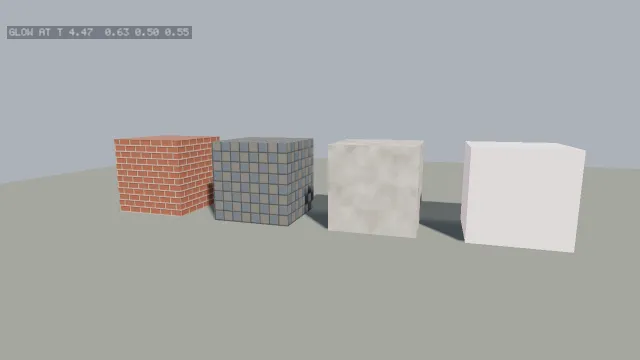
Starts examples/drifttexture in this page, on WebGPU where your browser has it.
Why a program
One object a material, not one a channel. A material's albedo, roughness and normal are three descriptions of the same scratches and wear. Encoding them apart pays for that structure three times; encoding them together fits one latent every channel decodes from.
Time is an argument. The decoder takes t from its caller, which is the simulation's clock, so
an animated texture replays byte for byte. The engine's tests assert it three ways: a run sampling an
animated texture every tick fingerprints identically to a run sampling nothing, the same simulation
run twice at different wall-clock times fingerprints identically, and a decoder reading a wall clock
instead is shown to diverge, so the first two cannot pass by accident.
The decoder is data, not shader permutations. A program is four words a node in a buffer, walked by one shader. A new operation is one more case in one switch, and a thousand materials are a thousand programs and still one pipeline.
Conventions are declared, so nothing downstream guesses. A channel says it is an sRGB albedo, a Y-down tangent-space normal or a gloss, and comes back linear, Y-up and as roughness. The sRGB curve is the exact one: the midpoint linearises to 0.2140, not the 0.2176 of the 2.2 approximation.
The program
/** A marble: five octaves of noise, with a warm white laid over it at half strength. */
const marbleGraph = createDecodeGraph(3);
addDecodeNode(marbleGraph, DECODE_OP.PROCEDURAL_FBM, 7, 5, 0);
addDecodeNode(marbleGraph, DECODE_OP.CONSTANT, 0, 0, 1);
addDecodeNode(marbleGraph, DECODE_OP.COMPOSITE, 1, 0, 2);
marbleGraph.result = 2;
marbleGraph.addressMode = ADDRESS_MODE.CENTRE_WRAP;
const marbleConstants = Float32Array.of(0.95, 0.9, 0.82, 0.55);

/** A glow that sweeps from amber to blue once a second of the time it is given. */
const glowGraph = createDecodeGraph(3);
addDecodeNode(glowGraph, DECODE_OP.CONSTANT, 0, 0, 0);
addDecodeNode(glowGraph, DECODE_OP.CONSTANT, 1, 0, 1);
addDecodeNode(glowGraph, DECODE_OP.LATENT_LERP, 0, 1, 2);
glowGraph.result = 2;
const glowConstants = Float32Array.of(1, 0.55, 0.15, 1, 0.2, 0.45, 1, 1);

/** A graph and its constants, as the device's program: no latent and no network to carry. */
const procedural = (graph: DecodeGraph, constants: Float32Array): GpuDrivenProgram => ({
  graph,
  latents: [],
  networks: [],
  constants,
});createDecodeGraph(capacity) makes an empty program and addDecodeNode(graph, op, a, b, out)
appends an instruction writing register out, of which there are MAX_REGISTERS (16), each four
components. result names the register holding the finished value, and addressMode says where
coordinates land, as one of ADDRESS_MODE:
ADDRESS_MODE.LATTICE_CLAMPandADDRESS_MODE.LATTICE_WRAPputu = 0on the first texel's centre, which a heightfield sampled at its own vertices wants.ADDRESS_MODE.CENTRE_CLAMPandADDRESS_MODE.CENTRE_WRAPput it on the first texel's edge, as every GPU sampler does, which a surface tiled across a mesh wants.
The instructions:
| Operation | a |
b |
Writes |
|---|---|---|---|
DECODE_OP.SAMPLE_LATENT |
a latent slot | The latent at (u, v) | |
DECODE_OP.EVAL_NETWORK |
the input register | a network slot | The network's outputs |
DECODE_OP.SAMPLE_BLOCK |
a block slot | Raw bytes at (u, v): an ordinary picture | |
DECODE_OP.PROCEDURAL_FBM |
a seed | octaves | Fractal noise, in all three colour lanes |
DECODE_OP.FLIPBOOK_INDEX |
frames | frames per second | The frame the time lands on, looping |
DECODE_OP.LATENT_LERP |
a register | a register | The two mixed by the fractional part of the time |
DECODE_OP.REMAP_CHANNEL |
a register | a packed channel spec | That register with one channel's convention applied |
DECODE_OP.COMPOSITE |
a register | a register | a over b, by a's alpha |
DECODE_OP.CONSTANT |
a constant slot | Four numbers from the program's constants |
validateDecodeGraph(graph) returns null for a program an interpreter can run and a message for
one it cannot: an unknown operation, a register out of range, a register read before anything wrote
it, a result nothing writes. graphRegisterCount, nodeOp, nodeA, nodeB and nodeOut read a
program back, and encodeDecodeGraph and decodeDecodeGraph turn one into words and back.
On the CPU
/**
 * Noise read as gloss, which the remap hands back as roughness: a channel says what convention it
 * was authored in, and comes back in the one the renderer uses.
 */
const graph = createDecodeGraph(2);
addDecodeNode(graph, DECODE_OP.PROCEDURAL_FBM, 3, 4, 0);
const gloss = (REMAP_SEMANTICS.indexOf('gloss-linear') << 4) | 0;
addDecodeNode(graph, DECODE_OP.REMAP_CHANNEL, 0, gloss, 1);
graph.result = 1;
graph.addressMode = ADDRESS_MODE.CENTRE_WRAP;

/** `null` for a graph an interpreter can run; otherwise what is wrong with it. */
export const problem = validateDecodeGraph(graph);

/** The roughness at one point, at simulation time zero. Registers are reused between calls. */
const registers = createDecodeRegisters();
export const roughness = new Float32Array(4);
decodeCpu(graph, { latents: [], blocks: [], networks: [] }, 0.25, 0.75, 0, roughness, registers);decodeCpu(graph, resources, u, v, t, out, registers, lod) runs a program at one point and writes
the four-component result. resources holds the latents, blocks, networks and constants the
program's slots name; registers comes from createDecodeRegisters() and is reused so a decode
allocates nothing. lod picks a mip level, so the GPU's trilinear sample has a reference at every
level.
A channel spec for DECODE_OP.REMAP_CHANNEL packs a semantic's index in REMAP_SEMANTICS above its
component: (index << 4) | component. The semantics are CHANNEL_SEMANTICS: albedo-srgb,
albedo-linear, normal-tangent-yup, normal-tangent-ydown, roughness-linear, gloss-linear,
metallic-linear, occlusion-linear, height-linear, emissive-srgb and mask-linear.
semanticIndex and semanticAt convert, isColour and needsVarianceMips say which need a
transfer curve or a normal-preserving mip, and srgbToLinear, linearToSrgb and normaliseSample
are the conversions themselves.
On the GPU
/** Material 0 is the ground; the rest wear DriftTexture programs. A cube's faces span 0 to 1, so
    a scale of three tiles the bricks three times across each face. */
const materials: GpuDrivenMaterial[] = [
  { tint: [0.4, 0.42, 0.38], emissive: 0, roughness: 0.9 },
  {
    tint: [1, 1, 1],
    emissive: 0,
    roughness: 0.85,
    textures: {
      baseColour: programFromEncoded(bricks.baseColour),
      normal: programFromEncoded(bricks.normal),
      uScale: 3,
      vScale: 3,
    },
  },
  {
    tint: [1, 1, 1],
    emissive: 0,
    roughness: 1,
    textures: {
      baseColour: programFromEncoded(chequer.baseColour),
      orm: programFromEncoded(chequer.orm),
      uScale: 1,
      vScale: 1,
    },
  },
  {
    tint: [1, 1, 1],
    emissive: 0,
    roughness: 0.3,
    textures: { baseColour: procedural(marbleGraph, marbleConstants), uScale: 1, vScale: 1 },
  },
  {
    tint: [0.8, 0.8, 0.8],
    emissive: 1.2,
    roughness: 0.5,
    textures: { emissive: procedural(glowGraph, glowConstants) },
  },
];A GPU-driven material takes textures: a GpuDrivenProgram for any
of baseColour, normal, orm (occlusion, roughness and metallic in R, G and B) and emissive,
with uScale and vScale to tile them and the strengths SurfaceMaterial has. A program is a
graph and its resources in bytes: latents, blocks, networks and constants.
programFromEncoded(encoded) builds one from an encoded material, and packDecodeTables is what
the pass flattens every material's programs into. A material with no programs draws exactly as it
did without them.
/* The decode reads this, never a clock of its own, so a held or replayed time decodes alike. */
view.time = decodeTime;
decodeCpu(glowGraph, glowResources, 0.5, 0.5, decodeTime, sampled, registers);The pass reads the time an animated program samples from its view's time, in seconds of the
simulation's clock, never from a clock of its own.
Encoding a material
/** Channels written in code, 64 texels square, then encoded jointly into one latent. */
const SIZE = 64;
function channel(
  semantic: ChannelInput['spec']['semantic'],
  component: number,
  value: (x: number, y: number) => number,
): ChannelInput {
  const data = new Float32Array(SIZE * SIZE);
  for (let y = 0; y < SIZE; y += 1)
    for (let x = 0; x < SIZE; x += 1) data[y * SIZE + x] = value(x, y);
  return { spec: { semantic, component }, data };
}

/** Tiling, full resolution, addressed at texel centres: what a surface texture wants. */
const encode = (channels: readonly ChannelInput[]): EncodedMaterial =>
  encodeMaterial(channels, SIZE, SIZE, { quality: 1, addressMode: ADDRESS_MODE.CENTRE_WRAP });

/** Courses of bricks: their colour, and a normal that turns at the mortar. */
const mortar = (x: number, y: number): boolean => y % 16 < 2 || (x + ((y >> 4) & 1) * 16) % 32 < 2;
const bevel = (offset: number): number => (offset === 2 ? 0.55 : offset === 31 ? -0.55 : 0);
const nx = (x: number, y: number): number => bevel((x + ((y >> 4) & 1) * 16) % 32);
const ny = (_x: number, y: number): number => bevel(y % 16 === 2 ? 2 : y % 16 === 15 ? 31 : 0);
const bricks = {
  baseColour: encode([
    channel('albedo-linear', 0, (x, y) => (mortar(x, y) ? 0.7 : 0.55)),
    channel('albedo-linear', 1, (x, y) => (mortar(x, y) ? 0.68 : 0.22)),
    channel('albedo-linear', 2, (x, y) => (mortar(x, y) ? 0.64 : 0.15)),
  ]),
  normal: encode([
    channel('normal-tangent-yup', 0, (x, y) => nx(x, y) * 0.5 + 0.5),
    channel('normal-tangent-yup', 1, (x, y) => ny(x, y) * 0.5 + 0.5),
    channel(
      'normal-tangent-yup',
      2,
      (x, y) => Math.sqrt(Math.max(0, 1 - nx(x, y) ** 2 - ny(x, y) ** 2)) * 0.5 + 0.5,
    ),
  ]),
};

/** A chequer of polished metal and rough stone: colour, and occlusion, roughness and metal. */
const tone = (x: number, y: number): number => ((x >> 3) + (y >> 3)) & 1;
const chequer = {
  baseColour: encode([
    channel('albedo-linear', 0, (x, y) => (tone(x, y) ? 0.85 : 0.25)),
    channel('albedo-linear', 1, (x, y) => (tone(x, y) ? 0.8 : 0.3)),
    channel('albedo-linear', 2, (x, y) => (tone(x, y) ? 0.7 : 0.35)),
  ]),
  orm: encode([
    channel('occlusion-linear', 0, (x, y) => (x % 8 === 0 || y % 8 === 0 ? 0.45 : 1)),
    channel('roughness-linear', 1, (x, y) => (tone(x, y) ? 0.25 : 0.85)),
    channel('metallic-linear', 2, (x, y) => (tone(x, y) ? 0.6 : 0)),
  ]),
};encodeMaterial(channels, width, height, options) in @driftengine/assets fits one latent for a
set of channels, each a ChannelInput: a ChannelSpec of semantic and component, and its values.
quality from 0 to 1 sets the latent's resolution, an eighth of the source up to all of it, and
addressMode how it tiles. The result, an EncodedMaterial, carries the latent and its mips, a
small network and the two-node program that samples one and evaluates the other.
The fit is a principal-component basis over the channel vectors: exact, deterministic and cheap.
Channels that move together share a component, and a component is kept only where it explains
enough of the channels to be worth its bytes, at most three. A sandstone whose
three colour channels rise and fall together encodes into a single component. Normal maps get
rougher toward their small mips instead of sparkling: the encoder writes the disagreement between
four averaged normals into roughness, which is why both live in one object
(reduceNormalMip, toksvigRoughness).
A network is evaluated by evalNetwork, and by evalNetworkHalf at the half precision a device
runs, with halfPrecisionErrorBound saying how far the two may differ. @driftengine/texture also
exports the tensor operations its networks are built from, for a caller with a network of its own.
latentImageOf(encoded) gives the latent as the CPU decoder reads it.
In a .drft
/** Three channels of a sandstone written in code, encoded jointly, and carried as a `DTEX`. */
const SIZE = 32;
const band = (y: number): number => 0.5 + 0.5 * Math.sin(y * 0.6);
const sandstone: ChannelInput[] = [0.78, 0.6, 0.42].map((base, component) => ({
  spec: { semantic: 'albedo-linear', component },
  data: Float32Array.from({ length: SIZE * SIZE }, (_, i) =>
    Math.min(1, base * (0.8 + 0.3 * band(Math.floor(i / SIZE)))),
  ),
}));
const encoded = encodeMaterial(sandstone, SIZE, SIZE, {
  quality: 0.5,
  addressMode: ADDRESS_MODE.CENTRE_WRAP,
});

export const file = writeDrft({
  head: { name: 'sandstone' },
  meshes: [new MeshBuilder().addBox([0, 1, 0], [1, 1, 1], [1, 1, 1]).build()],
  materials: [STONE],
  /* Paired to its MATL entry by index, so a file may carry programs for some materials only. */
  dtex: [
    {
      material: 0,
      texture: dtexFromEncoded(
        encoded,
        sandstone.map((c) => c.spec),
      ),
    },
  ],
});

/** Read back: the chunk is data, and decoding it is the texture package's job. */
export const carried = readDrft(file).dtex;

/** The same latent as the decoder's input, for checking a bake against its source. */
export const latent = latentImageOf(encoded);dtexFromEncoded(encoded, channels, tileSize) turns an encoded material into a DtexMaterial, and
writeDrft carries each in a DTEX chunk paired to a MATL entry by the index it names, so a file
may carry programs for some materials and plain maps for the rest. The chunk holds the latent, what
each channel is, the program, the network's shape and weights, and a tile table.
The tile table is the streaming unit. With a tileSize, the latent is stored tile by tile and each
tile carries a 64-bit content hash, so two identical tiles anywhere in a bake share one payload and
a tile resident for one material is resident for every material sharing it. tileGridFromDtex
and dtexTileBytes read the table back for streaming.
The chunk validates containment, not meaning: a tile whose bytes run past the payload and a result
register no node writes are refused, since either would hand a reader arbitrary memory or an
uninitialised value. Whether a program runs is validateDecodeGraph's question. The chunk is
additive, so an older reader skips it by its length and loses only a material it could not have
decoded. DTEX_REGISTERS, DTEX_ADDRESS_MODES and DTEX_MAX_TILES are its limits.
Texture arrays and materials
WebGPU has no bindless textures, so a thousand materials as six thousand textures is out of reach.
DriftTexture materials bind as slices of a few arrays: createMaterialArray holds them,
assignLayer gives a latent its layer, sharing one between identical content, and layerOf and
arrayDescriptor describe the result. hashTile, createTileIndex, internTile and
tileSlotCount are the content addressing underneath.