 DriftEngine
Rendering
Light in the air
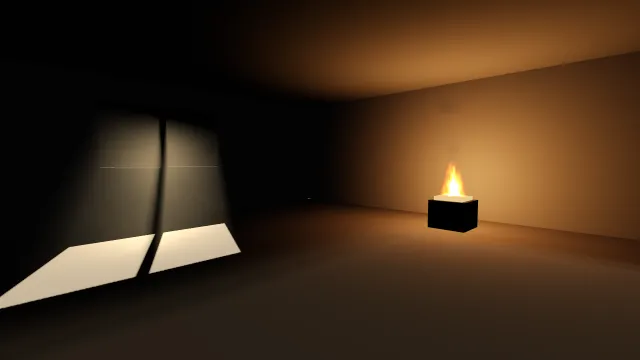
Shafts of light with dust in them, cut to shape by a window's shadow, fire and smoke plumes, and a medium that fills a room with light.
npm install @driftengine/core @driftengine/script
Light is seen on surfaces, and in the air only where something in the air catches it. The engine draws that three ways: a volume of light inside a hull you place, plumes of fire and smoke, and a medium that fills the whole frame. Haze over distance is fog, in Fog and weather.
Starts examples/air in this page, on WebGPU where your browser has it.
Shafts and beams
/**
 * A shaft through a window is a slice of a very wide cone whose apex is far out toward the sun.
 * The hull is round and wider than the window; the window's own shadow cuts it square.
 */
const REACH = 30;
const shaftHull = buildLightVolume({
  nearM: REACH,
  lengthM: REACH + 10,
  spread: 2.2 / REACH,
  color: [1, 0.86, 0.62],
});
const shaft = renderer.createMesh(shaftHull);

/** The hull opens along its own +Z, so its matrix turns +Z to the way sunlight travels. */
function aimAlong(out: Float32Array, at: Vec3, travel: Vec3): void {
  const [zx, zy, zz] = travel;
  const side = Math.hypot(zz, zx);
  const xx = zz / side;
  const xz = -zx / side;
  out.set([xx, 0, xz, 0, zy * xz, zz * xx - zx * xz, -zy * xx, 0, zx, zy, zz, 0, ...at, 1]);
}
const length = Math.hypot(...SUN);
const travel: Vec3 = [-SUN[0] / length, -SUN[1] / length, -SUN[2] / length];
const shaftModel = new Float32Array(16);
aimAlong(
  shaftModel,
  [6.1 - travel[0] * REACH, 2.3 - travel[1] * REACH, -travel[2] * REACH],
  travel,
);A light volume is a beam from a lamp, a cone under a street light, or a shaft of sun through a
window. buildLightVolume builds its hull, a closed cone frustum opening along its own +Z:
lengthM is how far the light reaches, spread is the cone's half-width over distance, and nearM
is where the drawn part starts. A shaft through a window is a slice taken far down a very wide cone
whose apex is out toward the sun, which is what nearM is for. sides sets how round the outline
is, twelve by default; the light inside is round whatever the hull.
renderer.drawLightVolume(shaft, shaftModel, camera, 0.8, REACH + 10, 2.2 / REACH, {
  nearM: REACH,
  dust: 0.35,
  dustScaleM: 0.8,
  driftM: [time * 0.05, 0, time * 0.02],
  sunShadow: 1,
  env,
});
renderer.drawPlumes(smoke, camera, time, env, 0.2, 0);
renderer.drawPlumes(fire, camera, time, env, 0.2, 0);drawLightVolume(mesh, model, camera, strength, length, spread, options) walks each pixel's line of
sight through the hull and adds what the air there would scatter. Pass the same length, spread
and nearM the hull was built with. They are read in the hull's own units, and a draw that
disagrees with its hull either ends at a hard edge or disappears. strength fades the whole volume,
for a lamp coming up at dusk, and is clamped to 1.
The options:
dust, 0 to 1, gives the air structure: 0.2 to 0.5 reads as motes in sunlight, more as smoke.dustScaleMis the size of a cell of the dust field anddriftMwhere the field has drifted to, a position so the same instant always draws the same frame.sunShadow, 0 to 1, cuts the volume by the sun's shadow map at every step of the walk. That is what makes the round hull in the example square: the window frame shadows the air as well as the floor. It needsenvand a renderer built withdirectionalShadows.mediumties the volume to the weather:{ atmosphere, fullAtDensity }draws it as authored at that fog density, dimmer in clearer air and no brighter in thicker. A headlight in fog then reads differently from the same headlight on a clear night.
A volume is depth tested, so a beam passes behind whatever stands in front of it, and it occludes
nothing. The lightVolumeSamples quality option, 32 by default, is how many steps each ray takes;
the walk is dithered per pixel, which turns banding into grain. A frame that draws no volume pays
nothing.
Fire and smoke
/** Fire adds light; smoke covers it. One batch each, placed once. */
const fire = renderer.createPlumes([{ x: -1, y: 0.8, z: 4.5, width: 0.35, height: 1.1 }], {
  material: 'fire',
  blend: 'additive',
  windResponse: 0.1,
});
const smoke = renderer.createPlumes(
  [
    { x: -1, y: 1.6, z: 4.5, width: 0.5, height: 1.4 },
    { x: -0.9, y: 2.6, z: 4.4, width: 0.8, height: 1.4 },
  ],
  { material: 'smoke', blend: 'alpha', windResponse: 1, tint: [0.35, 0.33, 0.32] },
);createPlumes(placements, options) makes a batch of plumes, each a position, a half-width and a
height, animated on the GPU. A plume is two crossed blades fixed in the world, so walking around a
fire shows it from every side. The options:
material: one the engine ships,'fire','smoke'or'arcane'.blend:'additive'for what emits light,'alpha'for what covers it.windResponse: how far the plume leans per metre a second of wind at its crown. Smoke is carried; a flame is anchored to its fuel.sizePulse: how much the quads swell and shrink. It is visual only, so a gameplay volume must keep its own fixed size.tint: the colour, white by default.
drawPlumes(plumes, camera, time, env, windX, windZ) draws a batch after the opaque scene; pass the
same wind the grass and the dust use. A batch is placed once, since fires do not move, and
setPlumeScale(plumes, index, scale) resizes one plume, 0 to hide it: an oil slick that burns on a
cycle. The plumeNoiseOctaves quality option sets how much detail the noise has, 3 by default.
A plume does not light anything. The brazier in the example has a flickering point light beside its fire for that.
The air itself
fn breathe(air: mut Air, renderer: Renderer, dt: f32) {
    // Half of the change a second, either way.
    air.present = air.present + math.clamp(air.wanted - air.present, 0 - dt * 0.5, dt * 0.5)
    // Extinction per metre, how much of it comes back as light, how far forward it scatters, and
    // how far the march looks. A density of 0 is no air at all, and costs nothing.
    render.medium(renderer, 0.035 * air.present, 0.9, 0.6, 40)
}The example's air is a DriftScript module. Its switch says whether the room should hold air, and
breathe eases toward that and sets the medium with render.medium, the script's form of
setGlobalMedium(density, albedo, anisotropy, maxDistance). That call fills the frame with a
participating medium and marches every pixel's line of sight through it, adding the sunlight the air there scatters
toward the eye. Where the sun's shadow map says a point is in shade, it adds nothing, which is how a
window throws shafts across the whole room and a doorway its shape onto the floor.
densityis extinction per metre. 0.02 leaves a wall 50 metres away a third obscured, 0.1 is thick weather, and above about 0.5 nothing past a room is visible. 0 is off, and off is free: nothing is allocated and no pass runs.albedo, 0 to 1, is how much of what the air takes out comes back as light: near 1 for fog, cloud and steam, lower for soot.anisotropy, -1 to 1, is how much the medium scatters forward. Haze is strongly forward, around 0.6, which is why the air around a low sun glows and the air behind you does not.maxDistanceis where the march stops looking for light to scatter; extinction still applies past it.
The medium is a dial and is held until changed, so weather can move every frame. What it may cost
is a quality option: globalMediumSteps is the march's step count, 0 by default, which turns the
medium off whatever the frame asks for. 24 suits a room, 48 a landscape under a low sun, and 64 is
the most. globalMediumHalfResolution, on by default, marches a quarter of the pixels and upsamples
by depth. On parts the engine knows are weak, steps are capped at 16 unless capabilityClamp is off.
The example sets the ceiling once, at 48, and its switch only moves the density: at 0 nothing runs,
so the ceiling costs nothing until the air is there.
The medium is composited before the post chain, so bloom sees a lit fog bank as brightness. It reads
the sun's shadow map only on frames that drew it, with shadowStrength above zero.