 DriftEngine
Simulation
Rigid bodies
A deterministic physics world of boxes, spheres, capsules, cylinders, hulls and meshes, with soft contacts, sleeping islands and a fingerprint.
npm install @driftengine/physics @driftengine/script
@driftengine/physics is a rigid-body world stepped on the fixed clock. It imports no other engine
package, so a deterministic simulation runs with no renderer in its module graph: in Node, in a
worker, or on a server holding the authoritative copy of a game. Core re-exports every name in it,
so reaching for physics through the core barrel works as well. It costs 45.4 KB gzipped on its own.
The example is a wall of crates, a ramp with wheels, a capsule, a ball and a rock rolling down it, and a cannon firing at the wall. The cannon is a DriftScript module. The readout's fingerprint is the whole world as one number.
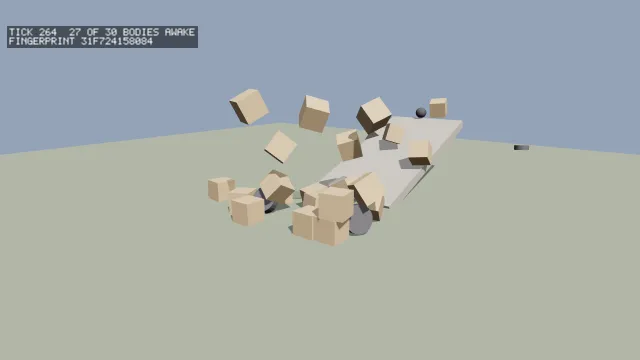
Starts examples/physics in this page, on WebGPU where your browser has it.
A world
/** The ground, a ramp, a wall of crates and things to roll down the ramp. */
let world = new PhysicsWorld();
let ball = 0;

function build(friction: FrictionModel, substeps: number): void {
  world = new PhysicsWorld({ frictionModel: friction, substeps });
  drawnAs.length = 0;
  world.addBody({ type: BODY_STATIC, shape: boxShape(30, 0.5, 30), y: -0.5, friction: 0.8 });
  /* A ramp turned twenty degrees about z, falling toward the wall. */
  const half = (20 * Math.PI) / 360;
  world.addBody({
    type: BODY_STATIC,
    shape: boxShape(5, 0.25, 2.5),
    x: 9,
    y: 1.6,
    qz: Math.sin(half),
    qw: Math.cos(half),
  });

  const body = (desc: Parameters<PhysicsWorld['addBody']>[0], drawn: MeshHandle): number => {
    const index = world.addBody(desc);
    drawnAs[index] = drawn;
    return index;
  };
  /* The wall: six crates along the bottom, one fewer each row up. */
  for (let row = 0; row < 6; row += 1) {
    for (let i = 0; i < 6 - row; i += 1) {
      body(
        {
          type: BODY_DYNAMIC,
          shape: boxShape(0.5, 0.5, 0.5),
          x: 0,
          y: 0.5 + row,
          z: i - (5 - row) / 2,
          friction: 0.6,
          density: 120,
        },
        CRATE,
      );
    }
  }
  /* Down the ramp: wheels standing on their rims, capsules lying across it, balls and a rock. */
  const quarter = Math.SQRT1_2;
  for (let i = 0; i < 3; i += 1) {
    body(
      {
        type: BODY_DYNAMIC,
        shape: cylinderShape(0.6, 0.2),
        x: 12,
        y: 4.2,
        z: i * 1.4 - 1.4,
        qx: quarter,
        qw: quarter,
      },
      WHEEL,
    );
  }
  body(
    {
      type: BODY_DYNAMIC,
      shape: capsuleShape(0.3, 0.4),
      x: 11,
      y: 4.2,
      z: 2,
      qx: quarter,
      qw: quarter,
    },
    PILL,
  );
  body(
    { type: BODY_DYNAMIC, shape: sphereShape(0.45), x: 13, y: 5, z: 0.6, restitution: 0.3 },
    BALL,
  );
  body({ type: BODY_DYNAMIC, shape: hullShape(ROCK_POINTS), x: 10.5, y: 4.4, z: -2 }, ROCK);
  /* The cannon's ball, parked out of the way until the script fires it. */
  ball = body(
    { type: BODY_DYNAMIC, shape: sphereShape(0.35), x: -14, y: 0.35, z: 0, density: 7800 },
    SHOT,
  );
}new PhysicsWorld(options) takes its quality and feel dials once:
substeps, integrate-and-solve passes a tick, anditerationsa substep. Constraints are soft, each a stiffness in hertz with a damping ratio, so raisingsubstepsbuys accuracy and changes no behaviour: a stack rests at the same height and a ball bounces as high.gravityX,gravityYandgravityZ;linearDampingandangularDamping.contactHertzandcontactDamping, andjointHertzandjointDamping, stiffer, since a joint is a structural relationship.speculativeMargin, how far apart two shapes may be and still get a constraint.allowSleep, on by default.frictionModel,'box'by default or'elliptical'. Box friction clamps each tangent axis on its own, so a slide along the diagonal between them meets up to√2times the grip it meets along an axis: measured, 0.737 metres of travel against 1.064 from the same 4 m/s. Elliptical couples them, and the distance is 1.06 metres whatever the heading, which is what friction physically is. It is not the default because every stacking result moves under it, and a stored replay or a golden fingerprint is something a game keeps.workersandpool, for solving islands on other threads; see below.
world.step(dt) advances one fixed tick, always with the same dt. Contact events are drained
after the tick, so nothing samples a substep's state.
Bodies
addBody(desc) returns the body's index. A BodyDesc names:
type:BODY_STATIC, never moving;BODY_DYNAMIC, moved by forces and contacts;BODY_KINEMATIC, never pushed and never integrated: you move it withsetPositioneach tick, andsetVelocitytells contacts how fast it is moving.shape, one convex shape, orshapes, up toMAX_BODY_PARTS(32) of them as one body.density, 1,000 kilograms a cubic metre unless stated, which is water. The example's crates are 120 and its cannon ball 3,000.x,yandz, and a rotation as the quaternionqx,qy,qzandqw.frictionandrestitution.layerandmask, 32 bits each: two bodies collide only when each one's mask admits the other's layer (layersInteract).ignorePair(a, b)excludes one pair whatever their layers say, andallowPairundoes it.sensor, for a body that reports overlap and is never pushed out of it.
State lives in world.bodies, a BodySet of parallel arrays: posX, posY, posZ, the rotation
rotX, rotY, rotZ, rotW, the velocities velX, velY, velZ and angX, angY, angZ,
and count. Position and rotation are what a frame draws:
/** A body's model matrix, from its position and the quaternion the world integrates. */
const model = new Float32Array(16);
function placed(body: number): Float32Array {
  const b = world.bodies;
  const x = b.rotX[body] ?? 0;
  const y = b.rotY[body] ?? 0;
  const z = b.rotZ[body] ?? 0;
  const w = b.rotW[body] ?? 1;
  model[0] = 1 - 2 * (y * y + z * z);
  model[1] = 2 * (x * y + z * w);
  model[2] = 2 * (x * z - y * w);
  model[4] = 2 * (x * y - z * w);
  model[5] = 1 - 2 * (x * x + z * z);
  model[6] = 2 * (y * z + x * w);
  model[8] = 2 * (x * z + y * w);
  model[9] = 2 * (y * z - x * w);
  model[10] = 1 - 2 * (x * x + y * y);
  model[12] = b.posX[body] ?? 0;
  model[13] = b.posY[body] ?? 0;
  model[14] = b.posZ[body] ?? 0;
  model[15] = 1;
  return model;
}applyImpulse, applyForce, setVelocity and setPosition move a body from outside, waking its
island; bodyMass reads its mass, and sleeping(body) whether it has settled. removeBody(index)
fills the hole with the last body and returns that body's old index, or −1, so a game keeping body
indices follows the one it is told about.
Shapes
A ConvexShape is a point cloud and two kinds of rounding, with its separating features listed
once when it is built:
boxShape(hx, hy, hz), by half extents: eight corners.sphereShape(radius): one point and a radius.capsuleShape(radius, halfHeight): two points along y and a radius.cylinderShape(radius, halfHeight), standing along y: two points and a side radius that grows the shape by a disc, so the caps are flat and the rim is sharp. A wheel is a cylinder turned a quarter turn. A 32-sided prism wheel bobs 16 mm rolling at 6 m/s; a cylinder bobs under 2 mm.hullShape(points, radius), the convex hull of up to 64 points, from the few points that define a shape, never a render mesh.
shapeBounds measures one, shapeMassProperties and combineMassProperties give mass, centre and
inertia for a density.
A concave thing that moves is several hulls. decomposeConvex(positions, indices, options) cuts a
mesh into parts, each a hull's points, its volume and how full it is, with resolution,
maxHulls and concavity as its dials; it runs offline. Static concave geometry is a mesh:
meshShape(positions, indices) on a static body, where every triangle goes through the same narrow
phase, contacts are one-sided, rays are two-sided, and interior edges are filtered so a box sliding
across two coplanar triangles does not catch on their seam. Measured, a box slid at 6 m/s across
sixteen quads keeps 80% of its speed with the filter and 1% without. A heightfield is a shape of its
own, heightfieldShape, covered in Terrain.
Sleeping and islands
Bodies that touch, through contacts or joints, form an island, and only dynamic bodies join one, so
two towers on one floor are two islands. An island whose bodies have all been still for long enough
sleeps, counted in ticks, and wakes when something touches it. islandCount says how many there
were on the last tick.
No two islands share a body, so solving them in any order, or at once, gives the same bits. The
Executor seam runs them: SerialExecutor by default, ShuffledExecutor in a random order, which
the tests use to prove order does not matter, and DisjointExecutor. new PhysicsWorld({ workers, pool: createIslandPool }) solves on a pool of workers from @driftengine/physics/workers,
named at the call so a game that never asks for workers bundles none. It needs a cross-origin
isolated page, since it shares memory; without one the world stays serial, correct, and says why in
parallelism.reason.
Determinism
Contacts persist across ticks by feature, never by nearness within a tolerance, which is what makes
warm starting correct and independent of order. No angle appears anywhere in the solve: limits
compare cosines and quaternion components. The tick uses no sin, atan or pow that two engines
could round differently.
fingerprintBodies(world.bodies) hashes every body's state into one string, and two runs of the
same inputs reach the same one tick for tick: it is how a replay or a rollback session checks that
two machines agree. fingerprintColliders does the same for a ColliderSet.
From DriftScript
drift/physics reads and moves bodies of a world a script is handed:
// Called every tick with the tick's number. Answers whether it fired on this one.
fn fire(world: PhysicsWorld, ball: i32, tick: u32) -> bool {
    if tick % 150 != 30 {
        return false
    }
    let shot = tick / 150
    physics.setPosition(world, ball, -14, 1.2, random.range(shot, -1.5, 1.5))
    physics.setVelocity(world, ball, 30, random.range(shot + 1, 1, 4), random.range(shot + 2, -0.6, 0.6))
    physics.wake(world, ball)
    return true
}| Capabilities | What they do |
|---|---|
bodyCount, bodyX, bodyY, bodyZ, bodyVelX to bodyVelZ |
Read a body's position and velocity |
bodyMass, sleeping |
Its mass, and whether it has settled |
applyImpulse, applyForce, setVelocity, setPosition, wake |
Move it |
setGravity |
Change the world's gravity |
raycast, then hitBody, hitX, hitNormalX and the rest |
Cast a ray and read what it hit |
contactCount, contactKind, contactA, contactB |
Read the tick's contact events |
| Collider capabilities | Query and edit a ColliderSet; see Queries and colliders |
Reads are physics.read and are deterministic; writes are physics.write. The world reaches a
script as an argument, so the module needs no host service:
/** The cannon, hosted, and called once a tick with the world it fires into. */
const cannon = hostScript(cannonScript);
type Fire = (world: PhysicsWorld, ball: number, tick: number) => boolean;
if (import.meta.hot) {
  import.meta.hot.accept('./cannon.drs', (next) => {
    if (next !== undefined) patchModule(cannon, next as Record<string, unknown>, {});
  });
}