 DriftEngine
Worlds
Worlds from a kit
A world built from a few pieces placed many times, carried as its placements in a .drft, expanded by arithmetic, and paged in region by region.
npm install @driftengine/drft @driftengine/assets @driftengine/script
A city of boxes, columns and cornices is a few thousand distinct shapes placed hundreds of thousands
of times, each at its own size and in its own paint. Merged into vertices it is most of a gigabyte;
as placements of its pieces it is a few tens of megabytes. A .drft can carry a mesh either way,
and a mesh carried as placements is expanded into ordinary geometry where it is needed.
The example is a street built from three pieces, a box, a column and a sphere. Its figures say what
the street weighs as placements and as vertices. Lengthen the street, or paint each copy by the
piece it is, and save a change to the rules in street.drs to have the street built again.
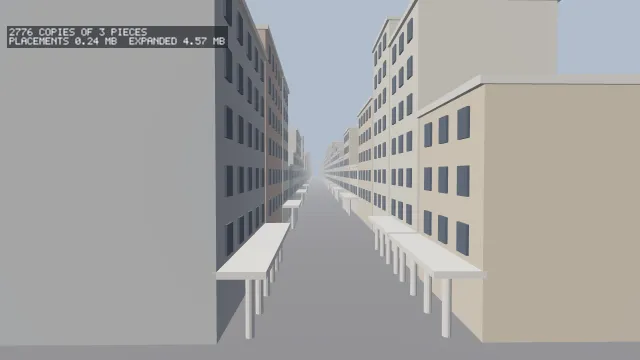
Starts examples/kit in this page, on WebGPU where your browser has it.
Pieces, surfaces and copies
/** The kit: three unit pieces. Their own colours are ignored; a copy's surface paints it. */
const WHITE: Vec3 = [1, 1, 1];
const PIECES: MeshData[] = [
  new MeshBuilder().addBox([0, 0, 0], [0.5, 0.5, 0.5], WHITE).build(),
  new MeshBuilder().addCylinder([0, 0, 0], 0.5, 0.5, 'y', WHITE, 0, 12).build(),
  new MeshBuilder().addSphere([0, 0, 0], 0.5, WHITE, 0, 16, 8).build(),
];
const BOX = 0;
const COLUMN = 1;
const SPHERE = 2;

/** The surfaces a copy can wear: four wall paints, glass, stone, copper and the road. */
const PAINTS: [Vec3, number][] = [
  [[0.78, 0.66, 0.52], 0],
  [[0.7, 0.52, 0.42], 0],
  [[0.82, 0.78, 0.68], 0],
  [[0.58, 0.6, 0.62], 0],
  [[0.12, 0.15, 0.2], 0.7],
  [[0.86, 0.84, 0.8], 0.1],
  [[0.36, 0.6, 0.5], 0.4],
  [[0.22, 0.22, 0.24], 0],
  /* And one per piece, for painting the street by which piece each copy is. */
  [[1, 0.5, 0.25], 0],
  [[1, 0.85, 0.3], 0],
  [[0.35, 0.6, 1], 0],
];
const GLASS = 4;
const STONE = 5;
const COPPER = 6;
const ROAD = 7;
const BY_PIECE = 8;
const surfaces = new Float32Array(PAINTS.length * SURFACE_FLOATS);
PAINTS.forEach(([colour, specular], i) => {
  surfaces.set(colour, i * SURFACE_FLOATS + SURFACE.color);
  surfaces[i * SURFACE_FLOATS + SURFACE.specular] = specular;
});A piece is an ordinary mesh, usually of unit size. A piece is shape only: its colours, emissive and
other per-vertex constants are ignored, and the copy's surface supplies them. A piece carries
positions and normals, texture coordinates and tangents where the result is textured, and its own
sway channel where the result sways, so a tree's sway rises from its root however it is placed.
A surface is SURFACE_FLOATS (12) numbers, laid out as SURFACE names them: color at 0,
emissive at 3, specular at 4, emissiveColor at 5, roughness at 8, grain at 9, relief
at 10 and the texture-array layer at 11. Only the values the assembly's attributes ask for are
read.
/** Copies collected for one street, before they become an assembly. */
const pieces: number[] = [];
const surfaceOf: number[] = [];
const transforms: number[] = [];
let paintByPiece = flag('paint', 'surfaces') === 'pieces';

/** One copy: a piece, a surface, and a box it fills, from its centre and its size on each axis. */
function place(piece: number, surface: number, centre: Vec3, size: Vec3): void {
  pieces.push(piece);
  surfaceOf.push(paintByPiece ? BY_PIECE + piece : surface);
  /* Three columns of the linear part, then the translation: a scale and a move. */
  transforms.push(size[0], 0, 0, 0, size[1], 0, 0, 0, size[2], centre[0], centre[1], centre[2]);
}

/** Lots down both sides of the street, each a building the rules describe. */
function buildStreet(lots: number): DrftAssembly {
  pieces.length = 0;
  surfaceOf.length = 0;
  transforms.length = 0;
  const storeys = rule<number>('storeys');
  const bays = rule<number>('bays');
  const arcaded = rule<boolean>('arcaded');
  const domed = rule<boolean>('domed');
  const paint = rule<number>('paint');
  const along = [0, 0];
  for (let lot = 0; lot < lots; lot += 1) {
    const side = lot % 2 === 0 ? -1 : 1;
    const width = bays(lot) * 3.2 + 1.6;
    const height = (storeys(lot) + 1) * 3.4;
    const z = (along[lot % 2] ?? 0) + width / 2;
    along[lot % 2] = z + width / 2 + 0.6;
    const front = side * 7;
    const middle = side * 13;
    const wall = paint(lot);
    place(BOX, wall, [middle, height / 2, z], [12, height, width]);
    place(BOX, STONE, [middle, height + 0.25, z], [12.6, 0.5, width + 0.3]);
    for (let floor = 1; floor <= storeys(lot); floor += 1) {
      for (let bay = 0; bay < bays(lot); bay += 1) {
        const across = z - width / 2 + 2.4 + bay * 3.2;
        place(BOX, GLASS, [front - side * 0.05, floor * 3.4 + 1.7, across], [0.2, 1.8, 1.4]);
      }
    }
    if (arcaded(lot)) {
      for (let column = 0; column <= bays(lot); column += 1) {
        const across = z - width / 2 + 0.8 + column * 3.2;
        place(COLUMN, STONE, [front - side * 1.6, 1.7, across], [0.5, 3.4, 0.5]);
      }
      place(BOX, STONE, [front - side * 1.2, 3.6, z], [2.8, 0.4, width]);
    }
    if (domed(lot)) place(SPHERE, COPPER, [middle, height + 0.5, z], [7, 7, 7]);
  }
  const length = Math.max(along[0] ?? 0, along[1] ?? 0);
  place(BOX, ROAD, [0, -0.1, length / 2], [60, 0.2, length + 40]);

  const copies = pieces.length;
  /* A stretch of one along each piece axis and no offset: untextured, so it changes nothing. */
  const uv = new Float32Array(copies * COPY_UV_FLOATS);
  for (let c = 0; c < copies; c += 1) uv.set([1, 1, 1, 1, 1, 1, 0, 0], c * COPY_UV_FLOATS);
  return {
    attributes: 0,
    surfaces,
    pieces: Uint32Array.from(pieces),
    surfaceOf: Uint32Array.from(surfaceOf),
    transforms: Float32Array.from(transforms),
    uv,
  };
}A DrftAssembly is the mesh described as copies:
attributes, the optional arrays the expanded mesh carries, as aMESH's attribute bits (ATTR_SPECULAR,ATTR_UVS,ATTR_TANGENT,ATTR_LAYERS,ATTR_CHANNELand the rest).ASSEMBLY_ATTRIBUTESis every bit an assembly may carry; skinning is not among them.surfaces, the surface table.piecesandsurfaceOf, one piece and one surface a copy.transforms,COPY_MATRIX_FLOATS(12) a copy: the three columns of the linear part, then the translation.uv,COPY_UV_FLOATS(8) a copy: how far a texture coordinate stretches along each of the piece's three axes for u, the same for v, and an offset. One along every axis and no offset leave a piece's coordinates as they are.
Expanding a copy
/** The street as a mesh, built again whenever the rules, the length or the paint change. */
let mesh: MeshHandle | null = null;
const readout = createReadout(renderer, 2);
let lots = Number(flag('lots', '128'));

function rebuild(): void {
  const assembly = buildStreet(lots);
  const expanded = expandAssembly(assembly, (ordinal) => PIECES[ordinal] as MeshData);
  const next = renderer.createMesh(expanded);
  if (mesh !== null) renderer.disposeMesh(mesh);
  mesh = next;

  const copies = assembly.pieces.length;
  /* What the file would carry: a surface table, then 88 bytes a copy. */
  const placed =
    12 + surfaces.byteLength + copies * (8 + (COPY_MATRIX_FLOATS + COPY_UV_FLOATS) * 4);
  const vertices =
    expanded.positions.byteLength +
    expanded.normals.byteLength +
    expanded.colors.byteLength +
    expanded.emissive.byteLength +
    (expanded.specular?.byteLength ?? 0) +
    expanded.indices.byteLength;
  readout.set(0, `${copies} COPIES OF ${PIECES.length} PIECES`);
  readout.set(
    1,
    `PLACEMENTS ${(placed / 1e6).toFixed(2)} MB  EXPANDED ${(vertices / 1e6).toFixed(2)} MB`,
  );
}expandAssembly(assembly, piece) builds the MeshData the assembly describes, given a function
that finds a piece by its mesh ordinal. Each copy's positions go through its matrix and its normals
through the matrix's inverse transpose, so a slope stretched along one axis stays perpendicular to
its surface. A copy whose matrix mirrors, with a negative determinant, has its triangles wound back
and its tangents' handedness flipped, so its faces still face outward and a mirrored texture still
lights the right way up. assemblyBounds(assembly, piece, out) gives the box the expanded mesh
will fill without expanding it.
A texture coordinate is stretched along the piece's own tangent, so one unit box can serve every box in a city: a copy 13 metres by 4 with stretches of its size over the texture's tile size repeats its facade in metres on every face. A stretch that varies across one face, as it does along a cone's side, comes out as the stretch at each vertex's own tangent.
The rules for each building are a DriftScript module, which the page calls once a lot:
// Floors above the ground, from two to seven.
fn storeys(lot: u32) -> u32 {
    return 2 + random.index(lot, 6)
}

// Windows across the front, from three to five.
fn bays(lot: u32) -> u32 {
    return 3 + random.index(lot + 101, 3)
}

// Two buildings in five stand on an arcade of columns.
fn arcaded(lot: u32) -> bool {
    return random.unit(lot + 7) < 0.4
}

// One in seven carries a dome.
fn domed(lot: u32) -> bool {
    return random.unit(lot + 13) < 0.15
}

// Which of the four wall paints a building wears.
fn paint(lot: u32) -> u32 {
    return random.index(lot + 29, 4)
}In a container
/** Two pieces, and a tower made of four copies of them: a body, a roof and two columns. */
const box = new MeshBuilder().addBox([0, 0, 0], [0.5, 0.5, 0.5], [1, 1, 1]).build();
const column = new MeshBuilder().addCylinder([0, 0, 0], 0.5, 0.5, 'y', [1, 1, 1]).build();

const surfaces = new Float32Array(2 * SURFACE_FLOATS);
surfaces.set([0.8, 0.7, 0.6], SURFACE.color);
surfaces.set([0.9, 0.9, 0.88], SURFACE_FLOATS + SURFACE.color);

const UNSTRETCHED = [1, 1, 1, 1, 1, 1, 0, 0];
export const tower: DrftAssembly = {
  attributes: 0,
  surfaces,
  /* By mesh ordinal in the file: 0 is the box and 1 the column. */
  pieces: Uint32Array.of(0, 0, 1, 1),
  surfaceOf: Uint32Array.of(0, 1, 1, 1),
  /* Per copy, the three columns of a scale and then where it stands. */
  transforms: Float32Array.of(
    ...[10, 0, 0, 0, 30, 0, 0, 0, 10, 0, 15, 0],
    ...[11, 0, 0, 0, 1, 0, 0, 0, 11, 0, 30.5, 0],
    ...[0.6, 0, 0, 0, 4, 0, 0, 0, 0.6, -3, 2, 6],
    ...[0.6, 0, 0, 0, 4, 0, 0, 0, 0.6, 3, 2, 6],
  ),
  /* No texture to stretch: a stretch of one along every piece axis, and no offset, a copy. */
  uv: Float32Array.of(...UNSTRETCHED, ...UNSTRETCHED, ...UNSTRETCHED, ...UNSTRETCHED),
};

/** The mesh it describes, as a `MESH` would have carried it. */
export const expanded = expandAssembly(tower, (ordinal) => (ordinal === 0 ? box : column));/** The kit names the pieces; the assembly stands in a mesh slot like any other mesh. */
const block = new MeshBuilder().addBox([0, 15.5, 0], [5.5, 15.5, 5.5], [0.75, 0.68, 0.6]).build();
export const district = writeDrft({
head: { name: 'district' },
meshes: [box, column, tower, block],
kit: [0, 1],
regions: [
{
id: 0,
bounds: [-6, 0, -6, 6, 31, 7],
levels: [
{ error: 0, meshes: [2] },
{ error: 1, meshes: [3] },
],
instances: [],
occluders: new Float32Array(0),
collision: null,
},
],
texturesFirst: true,
});writeDrft takes assemblies in meshes, where each stands in a mesh slot and counts as one in
every ordinal, so materials and regions name it like any other mesh. kit lists the ordinals of
the meshes that are pieces. Two chunks carry them:
KITSnames the pieces and is written ahead of the geometry. A piece is drawn only inside the meshes assembled from it; without the list, a streaming reader would draw every piece at the origin.MSHCcarries an assembly: its attribute bits, its surface table, and 88 bytes a copy.
Both are required, so a reader older than format 1.23 refuses such a file and names them. A piece
travels with the first region that copies it, among that region's meshes and ahead of its
assemblies, so the first regions a walker reaches arrive without the rest of the kit.
texturesFirst: true writes the pictures ahead of all geometry, for a world whose materials must be
ready before its first region; its first mesh then arrives later by the size of the pictures.
Measured on a two-kilometre city of 18.7 million triangles in 579,164 copies of 7,308 pieces: with its coarse levels, collision, lights, scene and pictures the file is 123 MB, and the 14 regions within 150 metres of its spawn point are whole after the first 7.1 MB.
buildKit, readKit, buildAssembly, readAssembly, checkAssembly, checkCopies and
isAssembly are the chunk-level reader and writer writeDrft and readDrft use, for a tool
that writes the chunks itself.
Paging the finest level
/**
 * Page a region's finest level in while the selection draws it, and out once the eye has left.
 * Until it is resident, the region is drawn at its next level.
 */
const paged = new Map<number, boolean>();
export function pageFinest(loader: DrftLoader, hlod: HlodSet): void {
  for (const region of loader.regions.values()) {
    if (region.levels[0]?.paged !== true) continue;
    const wanted = hlod.levelOf(region.id) === 0;
    if (paged.get(region.id) === wanted) continue;
    paged.set(region.id, wanted);
    loader.pageRegion(region.id, 0, wanted);
  }
}

/** The level to draw for a region the selection put at `level`. */
export function drawnLevel(loader: DrftLoader, id: number, level: number): number {
  const region = loader.regions.get(id);
  if (level === 0 && region?.levels[0]?.resident === false) return 1;
  return level;
}DrftLoader keeps a region's level that arrived as assemblies small, as the copies the file
carried, and marks it paged. pageRegion(id, level, resident) brings it up, expanding and
uploading each mesh on the loader's clocked queue over the next updates and turning resident
true when the last is up, or frees its meshes and keeps the copies. A level that is not paged
ignores it. The game decides from what it will draw: page in the levels
HlodSet is choosing, draw a coarser one until the fine one is resident,
and page out what the eye has left.
A reader of its own built on streamDrft is told the kit's pieces by onKit when KITS lands,
each piece by onPiece, and each assembly by onAssembly with a lookup for its pieces, all of
which have arrived by then. Without onAssembly, the stream expands an assembly itself and hands
the result to onMesh.
Two more options split a file between the loader and the game:
onImage(name, image)takes each picture as it decodes and the loader uploads none, for a game that packs every picture into a texture array of its own. Materials that name an image then draw untextured, which is the game's to answer.onMesh(mesh, ordinal)is offered each mesh no region holds; returntrueto take it, and it is neither uploaded as a part nor merged. For meshes a game draws its own way, such as a crowd it instances and moves every frame. A taken mesh leaves its upload budget and fade to the game.